


Georgia Car Accident Report Requirements: Complete Guide
July 25, 2026 | | Blog

Table of Contents
- Understanding Georgia Car Accident Report Requirements
- When Do You Have to Report a Car Accident in Georgia
- Georgia Code § 40-6-273 and Your Legal Obligations
- How to Get a Georgia Car Accident Report
- Georgia Accident Report Form SR-13 Explained
- Statute of Limitations for Georgia Car Accident Claims
- Consequences of Failing to Report Your Accident
- Post-Accident Timeline Checklist and Next Steps
Last Updated: July 25, 2026
Understanding Georgia car accident report requirements is essential for protecting yourself legally and ensuring your insurance claim is processed correctly. Failing to follow these rules can cost you significantly.
Get your free accident report from georgiaaccidentreport.com
What Triggers a Reporting Obligation
Not every accident requires a formal police report in Georgia. The state’s reporting threshold depends on the type and extent of damage involved.
If your accident involves property damage exceeding $500, you are legally required to report it. This threshold applies whether the damage is to your vehicle, another person’s vehicle, or other property at the scene. Any accident involving bodily injury, even minor cuts or bruising, must be reported to law enforcement immediately under Georgia Code § 40-6-273.
If the accident occurs on private property, such as a parking lot, you may report directly to the property owner’s insurance company rather than law enforcement in some cases. However, having an official police report is always advisable because it provides third-party documentation of fault and damages.
|
Accident Type |
Reporting Required |
Threshold |
Report To |
|---|---|---|---|
|
Property damage only |
Yes |
Over $500 |
Law enforcement or police |
|
Bodily injury (any amount) |
Yes |
Any injury |
Law enforcement immediately |
|
Fatality |
Yes |
Any fatality |
Law enforcement immediately |
|
Private property damage |
Yes |
Over $500 |
Property owner + law enforcement |
|
Minor damage under $500 |
No |
N/A |
Optional but recommended |
When Do You Have to Report a Car Accident in Georgia
Georgia law imposes strict deadlines for reporting accidents. You must report the accident at the scene if law enforcement is called or if anyone involved requests a police officer. If the accident occurs on a public roadway and involves injury or significant property damage, call 911 immediately.
If law enforcement is not called at the scene, Georgia law requires drivers involved in reportable accidents to file a report with their local police department or the Georgia Department of Driver Services (GDDS) within 10 days of the accident. This 10-day window is critical. Missing this deadline can result in administrative penalties, license suspension, and insurance complications.
Calling your insurance company does not satisfy the reporting requirement. Your insurance company will file their own claim report, but this is separate from the official police report required by Georgia law. The Uniform Motor Vehicle Accident Report (GDOT-523 form) is the official document recognized by the state and courts.
If the other driver left the scene without providing information, you have 24 hours to report a hit-and-run to law enforcement.
Georgia Code § 40-6-273 and Your Legal Obligations
Georgia Code § 40-6-273 governs accident reporting requirements for all drivers in the state and directly impacts your legal and financial obligations after a crash.
The statute requires drivers involved in accidents resulting in injury, death, or property damage over $500 to immediately stop at the scene and provide your name, address, vehicle registration number, and driver’s license number. The statute also requires you to provide reasonable assistance to anyone injured in the accident, which means calling 911 if someone is hurt and providing your insurance information. You do not need to admit fault or apologize.
When law enforcement arrives, you are required by Georgia Code § 40-6-273 to provide a statement about the accident. Be honest but careful in what you say. Stick to facts you directly observed, and avoid speculation about fault or the other driver’s actions.
How to Get a Georgia Car Accident Report
After the accident is reported, you’ll need to obtain a copy of the official police report for your insurance company, attorney, or personal records.
If a city police department responded to your accident, contact that city’s police records department directly. Most departments allow you to request reports by phone, email, or in person. Processing times typically range from 3 to 10 business days. If the Georgia State Patrol responded, you can request your report through the Georgia Department of Driver Services or directly from the State Patrol’s Records Bureau.
Georgia Accident Report simplifies this process by handling the legwork for you. Submit a free request through our platform and we retrieve your official police report without any cost or obligation. We work with all Georgia police departments and the State Patrol to ensure you get the authentic document your insurance company will accept.
Georgia Accident Report Form SR-13 Explained
The Uniform Motor Vehicle Accident Report, also called the GDOT-523 form or Georgia accident report form SR-13, is the standardized document used by all Georgia law enforcement agencies to document accidents.
The form captures essential information: date, time, and location; vehicle information for all parties involved; driver demographics and license numbers; insurance information; injury details; and a narrative description of how the accident occurred. This information flows directly to the Georgia Department of Driver Services, which maintains a centralized database of all reported accidents in the state. Insurance companies use this form to verify that an accident was actually reported to authorities and to cross-check the details provided by the drivers involved.
The form includes the officer’s assessment of contributing factors, traffic violations cited, and whether anyone was injured. It does not determine legal fault, that’s decided in court or by insurance companies, but it provides objective documentation of what happened.
Statute of Limitations for Georgia Car Accident Claims
Understanding the statute of limitations is crucial if you’re considering legal action or if you’ve been injured in the accident.
For property damage claims, you generally have four years from the date of the accident to file a lawsuit. For personal injury claims, you have two years from the date of injury to file a lawsuit. This two-year window is critical. If you’re injured but don’t realize the extent of your injuries immediately, consult with an attorney within the first year to ensure you don’t miss this deadline.
The statute of limitations does not affect your ability to file an insurance claim. Insurance claims can be filed at any time, but your insurance policy may impose its own deadlines for reporting accidents (typically 30 to 90 days). Missing your insurance company’s deadline can result in claim denial.
Consequences of Failing to Report Your Accident
The penalties for failing to report an accident that meets Georgia’s reporting threshold are substantial. If you fail to report an accident involving injury or property damage over $500, you can be charged with a misdemeanor. Conviction can result in fines up to $1,000 and up to 12 months in jail.
Your driver’s license can be suspended for failing to report an accident. The Georgia Department of Driver Services may suspend your license administratively, meaning you lose driving privileges before any court hearing. Insurance companies may deny your claim or cancel your policy if you fail to report an accident but later file an insurance claim. Your insurance premiums will increase after any at-fault accident, but the increase is more severe if the accident was unreported, potentially raising your rates by 20-40% or more.
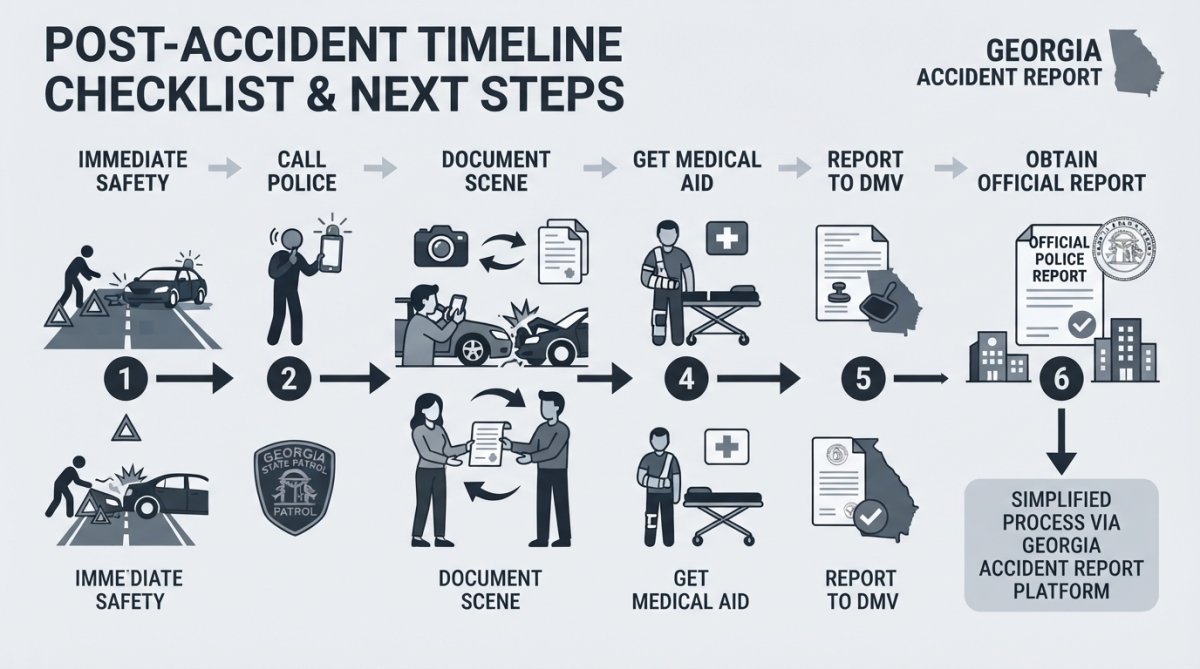
Post-Accident Timeline Checklist and Next Steps
The moments immediately following an accident are critical for protecting yourself legally and ensuring you have the documentation needed for insurance and potential legal claims.
At the accident scene, your first priority is safety. If anyone is injured, call 911 immediately. If the accident is minor and no one is hurt, move vehicles to a safe location if possible. Call the police if the accident involves injury, significant property damage, or if the other driver is uncooperative.
Exchange information with the other driver: name, phone number, address, driver’s license number, vehicle registration number, insurance company name, and policy number. Document the scene thoroughly with photos and video from multiple angles, including vehicle damage, the accident location, street signs, traffic signals, and road conditions.
Within 24 hours of the accident, contact your insurance company and report the accident. Within 10 days, ensure that a police report has been filed. Within 30 days, obtain a copy of the police report and review it for accuracy. If you were injured, consult with a medical professional within the first week and contact an attorney within 60 days.
|
Step |
Timeline |
Action |
Why It Matters |
|---|---|---|---|
|
Safety first |
Immediately |
Move to safety, call 911 if injured |
Prevents additional injuries |
|
Call police |
Immediately |
Report accident to law enforcement |
Creates official record |
|
Exchange info |
At scene |
Get other driver’s details |
Enables insurance claim |
|
Document scene |
At scene |
Photograph damage, conditions, injuries |
Provides evidence of fault |
|
Contact insurer |
Within 24 hours |
Report accident to your insurance company |
Initiates claim process |
|
File report |
Within 10 days |
Ensure police report is filed |
Meets legal requirement |
|
Obtain report |
Within 30 days |
Get copy of police report |
Verifies accuracy, supports claim |
|
Seek medical care |
Within 1 week |
Evaluate and document injuries |
Establishes injury timeline |
|
Consult attorney |
Within 60 days |
Discuss legal options if injured |
Protects statute of limitations |
After a car accident, the path forward depends on understanding your obligations under Georgia law and taking action quickly. The georgia car accident report requirements outlined in this guide, from the initial duty to report within 10 days to the two-year statute of limitations for personal injury claims, are designed to protect both you and other drivers on Georgia roads.
Georgia Accident Report removes the confusion from this process. Our free service handles the legwork of retrieving your official police report from any Georgia law enforcement agency, ensuring you have the documentation your insurance company needs to process your claim. We connect you with experienced car accident and injury lawyers who can evaluate whether you have a case and what your claim might be worth. Whether you’re dealing with a minor fender bender or a serious injury, starting with a free accident report request puts you in control of your recovery process.
Frequently Asked Questions
What are the main Georgia car accident report requirements?
Georgia law requires drivers involved in accidents resulting in injury, death, or property damage to report the incident. Under Georgia Code § 40-6-273, you must exchange information with other drivers and notify law enforcement if the accident causes injury or significant damage. The Uniform Motor Vehicle Accident Report (GDOT-523 form) documents crash data for the Georgia Department of Driver Services. Failure to report can result in traffic citations, insurance claim denial, and premium increases.
How long do I have to report a car accident in Georgia?
You must report an accident to law enforcement immediately if it involves injury, death, or property damage. For insurance purposes, contact your insurance company as soon as possible—most insurers require notification within 24-48 hours. The statute of limitations for filing a negligence claim is generally two years from the accident date, but don't wait to report; delays can complicate liability determination and claims adjuster investigations.
What information do I need to exchange at the accident scene?
Exchange names, phone numbers, addresses, driver's license numbers, and vehicle information with other drivers. Get their insurance company details and policy numbers. Note vehicle damage assessment details, road hazards, highway markings, and traffic conditions. Take photos of the accident scene, vehicle positions, and damage. If law enforcement arrives, obtain the officer's name and badge number. This documentation supports your insurance claim and helps establish liability.
How do I get a copy of my Georgia accident report?
Contact the police department or law enforcement agency that responded to your accident. Provide your case number, accident date, and location. You can request the official police report in person, by mail, or online through some departments. Georgia Accident Report offers a free service to retrieve your official report without the hassle of contacting multiple agencies directly, ensuring you receive the document your insurance company needs.
What is the statute of limitations for a Georgia car accident claim?
Georgia's statute of limitations for car accident injury claims is two years from the date of the accident. For property damage claims, you typically have two years as well. However, don't delay—evidence degrades, witnesses become harder to locate, and crash data may be archived. Filing an insurance claim promptly and obtaining your official accident report early protects your rights and strengthens your case with the claims adjuster.
What happens if I don't report my Georgia car accident?
Failing to report an accident can result in traffic citations, fines, and license suspension. Your insurance company may deny your claim if you fail to report timely, and your premiums will increase. If you hit an unattended vehicle or property, leaving the scene without reporting is a hit-and-run offense with serious legal consequences. Always report accidents to law enforcement and your insurer immediately to avoid these penalties.
Can I report a car accident on private property in Georgia?
Yes, accidents on private property still require reporting if they involve injury or significant damage. While private property accidents may not always require law enforcement response, notifying your insurance company is essential. Document the accident scene, exchange information with other parties, and obtain a written statement from the property owner or manager. Your claims adjuster will guide you on whether to file a police report for private property accidents.
Request a copy of your free accident report:
"*" indicates required fields