

Do You Get Your Deductible Back After a Hit-and-Run?
November 2, 2026 | Firm Name | Blog
Last Updated: November 1, 2026
Quick Summary
Sometimes, but not automatically. Your own collision coverage usually pays for damage after a hit-and-run, and you pay the deductible first. Recovery depends on whether the other driver is identified and insured, so a hit and run deductible may be reimbursed through subrogation.
- You usually pay your collision deductible first, then your insurer pays the repair costs.
- Subrogation lets your insurer seek repayment from the at-fault driver or their insurer.
- If the driver is never identified, your deductible generally stays with you.
- Uninsured motorist property damage coverage may pay for repairs when the driver is unknown or uninsured.
- Ask your insurer in writing how any recovered money will be allocated to your deductible.
Table of Contents
- Collision Coverage and When It Applies
- Step by Step: Filing a Hit and Run Insurance Claim
- Getting the Police Report You Need for Your Claim
- How Deductible Reimbursement Works and When Subrogation Applies
- What Happens If the Driver Is Never Identified
- Reimbursement Timelines, Claim Tracking, and Disputing a Denial
- Next Steps: Documenting Your Claim and Requesting Your Accident Report
- Frequently Asked Questions
To get your FREE accident report please fill out the yellow form.
Getting hit by a driver who then speeds away is stressful, and the first question most people ask is whether their insurance will pay. The short answer is that your own policy may cover the damage, even when the other driver is never found, but the details depend on the coverage you carry, including any hit and run deductible that applies to your claim. Learn what to do if the hit-and-run driver is never found. (Source: National Highway Traffic Safety Administration (NHTSA) data)
Hit-and-run damage is usually handled through your own auto policy rather than the at-fault driver’s. That means the coverage you bought matters a great deal. Some drivers have coverage that pays for repairs. Others have coverage that only pays for injuries. Checking your declarations page is the fastest way to see what you have.
Collision Coverage and When It Applies
Collision coverage is the part of an auto policy that pays to repair your car after a crash. It typically applies when your vehicle hits another vehicle or object, and it can also apply in a hit-and-run if your car is damaged in the incident.
- Collision coverage pays for damage to your own vehicle
- You usually pay your deductible first
- Repairs are paid up to your vehicle’s actual cash value minus the deductible
Watch out: Collision coverage is optional in many policies. Drivers who carry only liability insurance may have no coverage for their own car damage at all.
Uninsured Motorist Property Damage Coverage
Uninsured motorist property damage coverage, often called UMPD, can pay for damage to your vehicle when the at-fault driver cannot be identified or has no insurance.
Many drivers do not know this coverage exists. It is worth asking your insurer directly whether you carry it, because it may pay for repairs when collision coverage is not available, and whether a hit and run deductible would apply to the claim. Review your legal rights as a hit-and-run victim if the driver was never identified.
Step by Step: Filing a Hit and Run Insurance Claim
A clear sequence helps you protect your claim from the start. Follow these steps in order:
- Report the accident to police as soon as possible.
- Document the damage with photos from several angles.
- Write down everything you remember about the vehicle and driver.
- Notify your insurance company promptly.
- Request a copy of the police report once it is available.
- Get at least one repair estimate from a licensed shop.
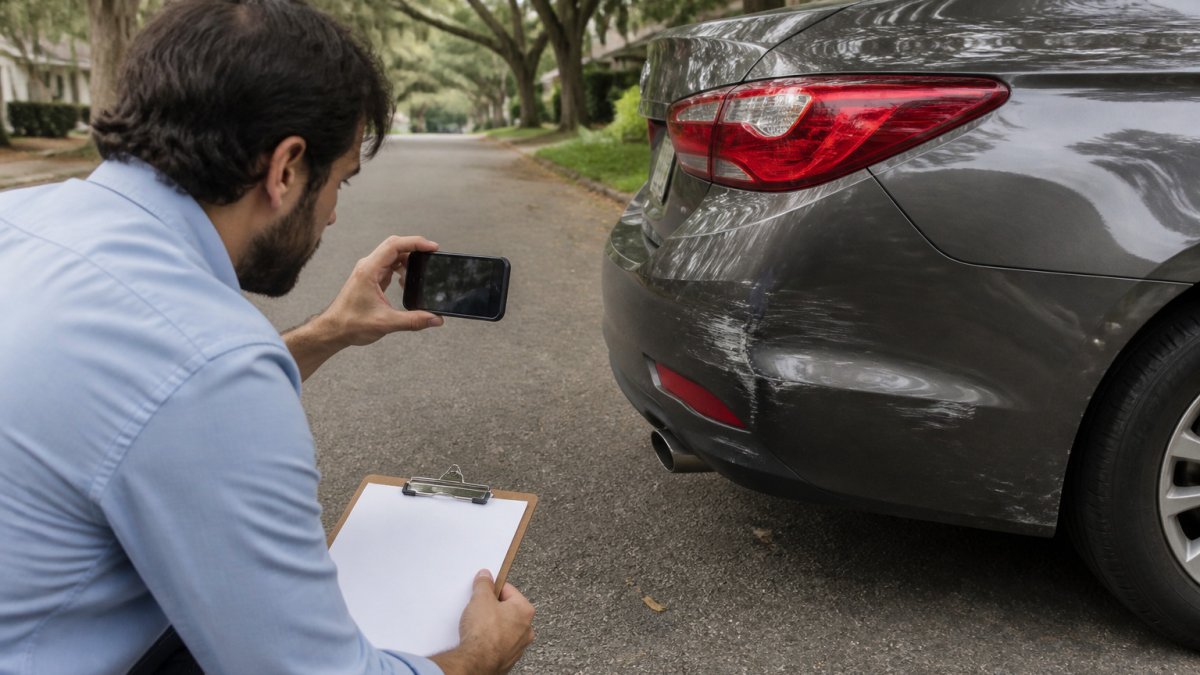
A driver photographing dented rear bumper damage on a parked car on a quiet Georgia street, with a clipboard and phone in hand, shows why documentation matters so much. Photos taken at the scene are often the strongest evidence you have.
Getting the Police Report You Need for Your Claim
Insurers often ask for a police report when reviewing a hit-and-run claim. The report confirms the date, time, location, and what happened. It also records any witnesses or partial plate numbers the officer collected.
Georgia Accident Report offers a free way to request your official accident report without calling several agencies.
- Reports can take time to appear, so request yours early
- Keep the report number for your insurer
- Check the report for errors and ask for a correction if needed
How Deductible Reimbursement Works and When Subrogation Applies
Deductible reimbursement is the process of getting back the amount you paid out of pocket under your collision coverage. In a hit-and-run, recovery is possible but never automatic, and the path from paying your deductible to seeing money returned follows a predictable sequence. Understanding that sequence is what separates a claim that gets reimbursed from one that quietly stalls.
The reimbursement path, step by step
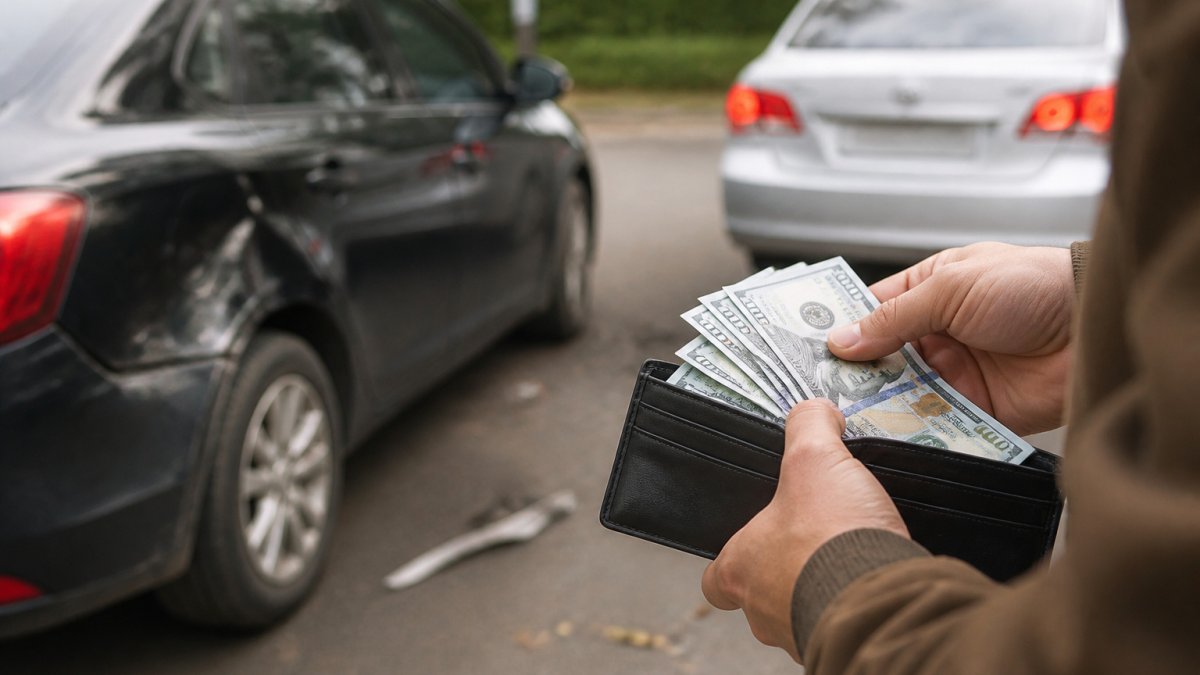
- You pay the deductible up front. Your insurer subtracts your collision deductible from the repair payment. If repairs are $3,000 and your deductible is $500, the insurer pays $2,500 and you pay the shop $500.
- Your insurer opens a subrogation file. Subrogation is the insurer’s right to seek repayment from the at-fault party after it pays your claim. The insurer pursues the other driver (or that driver’s insurer) for what it paid, and, in many policies, for your deductible too.
- The at-fault driver or insurer is identified and billed. If the other driver is found and has insurance, your insurer sends a demand package that includes your deductible. If the other insurer accepts liability, it typically reimburses your deductible directly or through your insurer.
- Recovery is allocated. When money comes back, the insurer applies it first to its own payment and then returns your deductible, subject to policy language and state rules. Some insurers reimburse the deductible automatically once recovery is received; others require you to ask.
- You receive a check or account credit. Reimbursement usually arrives as a separate check made out to you, though some insurers apply it as a credit. Ask your adjuster which method your policy uses.
When subrogation actually works, and when it does not
Subrogation depends on someone to pursue. Three scenarios cover most hit-and-run claims:
- Driver identified and insured. Your insurer demands the deductible from the other carrier. Recovery is common, though it can take months.
- Driver identified but uninsured. Your insurer may pursue the driver personally, but collection is often impractical. Your uninsured motorist property damage coverage (UMPD) may respond instead, and whether it covers the deductible depends on your policy and state rules.
- Driver never identified. There is no one to subrogate against. Your own collision coverage pays, and the deductible generally stays with you unless your policy includes a specific waiver.
Worked examples: partial versus full reimbursement
Full reimbursement. A driver with a $500 collision deductible has $3,000 in repairs. The insurer pays $2,500.
Partial reimbursement. The same $3,000 repair, but the other insurer disputes a portion of the damage and settles for $2,000. Your insurer applies the $2,000 to its $2,500 payment first.
No reimbursement. The driver is never found. Your insurer pays $2,500 and closes the subrogation file. Your $500 deductible is not recovered.
Request a copy of your free accident report →
What to ask your insurer in writing
- Does my policy include a deductible-reimbursement or deductible-waiver provision for hit-and-run claims?
- Will you pursue subrogation for my deductible, or only for your own payment?
- How will recovery be allocated between your payment and my deductible?
A common pattern is for insurers to reimburse the deductible only after recovery is actually received, not when liability is merely accepted. That distinction explains why two drivers with identical crashes can wait very different lengths of time for the same $500.
The table below summarises the three recovery scenarios the article describes for a hit-and-run claim.
|
Scenario |
What happens |
Deductible outcome |
|---|---|---|
|
Driver identified and insured |
Insurer demands deductible from other carrier |
Recovery is common, but can take months |
|
Driver identified but uninsured |
Insurer may pursue driver personally |
UMPD may respond; depends on policy and state rules |
|
Driver never identified |
No one to subrogate against |
Deductible generally stays with you |
What Happens If the Driver Is Never Identified
When the other driver is never found, the claim moves forward under your own policy, but the outcome depends heavily on which coverage you carry and where you live. This is the scenario where hit-and-run claims diverge most from ordinary crashes, and it is worth understanding before you file.
Which coverage responds, and in what order
- Collision coverage typically pays for your vehicle damage first, minus your deductible. It applies regardless of who caused the crash, which makes it the most reliable option when the other driver is unknown.
- Uninsured motorist property damage (UMPD) may pay when the at-fault driver cannot be identified or has no insurance. UMPD requirements and deductible rules differ from state to state, so check with your insurer and your state insurance department.
- Uninsured motorist bodily injury (UMBI) covers injuries to you and your passengers when the at-fault driver is unknown or uninsured. It does not pay for vehicle damage.
When reimbursement is unlikely
Reimbursement of your deductible depends on recovering money from someone. If the driver is never identified, there is no one to subrogate against, and your deductible generally stays with you. The same is usually true when the driver is identified but has no insurance and no collectible assets. In those cases, the realistic question is not “how do I get my deductible back” but “which of my own coverages limits what I pay out of pocket.”
How the outcome differs by policy and state
Deductible rules and uninsured motorist requirements vary. If the other driver had no insurance, learn what steps to take and how to file an uninsured motorist claim. Some states require insurers to offer UMPD, some permit a deductible waiver for hit-and-run claims, and some allow insurers to exclude hit-and-run damage from UMPD entirely. Policy language matters just as much: a deductible-waiver endorsement, for example, can eliminate the deductible in a documented hit-and-run, while a standard policy may not.
If the driver is identified but uninsured
The steps differ slightly. You will still report the accident, document everything, and file promptly, but your insurer may ask for proof that the other driver lacked insurance, often a copy of the police report or a statement from the other driver. Keep that documentation; it supports a UMPD claim and any later subrogation.
Reimbursement timelines and tracking your claim
Timelines vary widely. A straightforward collision claim may close in a few weeks; a subrogation file can take months, especially when fault or identity is unclear. Ask your adjuster for both the claim number and the subrogation claim number, and check status at a regular interval, every two to three weeks is a common practice. If recovery is received, confirm in writing how it was allocated between the insurer’s payment and your deductible.
If reimbursement is denied or incomplete
If your insurer denies a deductible reimbursement or returns less than you expected, you can act:
- Request the denial or allocation in writing, including the subrogation status and the settlement breakdown.
- Review the settlement breakdown to see how recovery was applied between the insurer’s payment and your deductible.
- Submit supporting documents, repair estimates, photos, the police report, and any correspondence with the other insurer.
- Ask for a supervisor review if the adjuster’s explanation does not match your policy language.
- Escalate by filing a complaint with your state insurance department if the dispute remains unresolved.
Reimbursement Timelines, Claim Tracking, and Disputing a Denial
Timelines vary widely, depending on how the claim and any recovery effort proceed. Ask your adjuster for a claim number and check its status regularly.
If your insurer denies or underpays your claim, you can request a written explanation and submit additional evidence. You may also ask for a supervisor review or contact the Georgia Office of Insurance and Safety Fire Commissioner.
- Request the denial reason in writing
- Gather repair estimates, photos, and the police report
- Submit a formal dispute with supporting documents
Next Steps: Documenting Your Claim and Requesting Your Accident Report
Organize everything in one folder: photos, estimates, the police report, and correspondence with your insurer. Good records make every later step easier.
Georgia Accident Report can help you request your official accident report at no cost, so you can move forward with your claim. You can also request a police accident report online in Georgia directly.
Frequently Asked Questions
Do you get your deductible back after a hit-and-run?
It depends on your coverage and whether the at-fault driver is found. If you carry collision coverage, your insurer can pay for the repair minus your deductible. You may then recover that deductible if the insurer later pursues the unidentified or identified driver through subrogation and wins a recovery. If you carry uninsured motorist property damage coverage in Georgia, that coverage may pay for the damage with a deductible that depends on your policy. Review your policy language and ask your insurer how your deductible will be handled.
Does uninsured motorist property damage cover a hit-and-run in Georgia?
Uninsured motorist property damage coverage may pay for damage to your vehicle when the at-fault driver is unidentified or uninsured and leaves the scene. Coverage terms, limits, and deductibles vary by policy, so check your declarations page and policy wording. Georgia law and your insurer’s rules determine eligibility, and you should confirm with your insurer whether a police report is required before a claim is accepted.
Do I need a police report for a hit-and-run insurance claim?
Most insurers ask for an official police report when a hit-and-run is alleged, because it documents the time, location, and circumstances of the collision. Reporting the incident promptly to law enforcement and obtaining the report helps support your claim and establishes that the accident occurred. Georgia Accident Report offers a free service to help you request your official accident report without contacting multiple agencies. Pricing for other services is not stated here; visit the website for current information.
How long does it take to get a deductible reimbursed after a hit-and-run?
Timelines vary widely because they depend on whether the at-fault driver is identified, how long the insurer’s investigation takes, and whether subrogation proceeds. Your insurer may pay the repair claim first and pursue recovery separately, which can take weeks or months. Ask your adjuster for a written claim status update and keep copies of your repair estimates, invoices, and correspondence to track progress.

Request a copy of your free accident report:
"*" indicates required fields