
How to Read an Accident Report Diagram
September 21, 2026 | | Blog
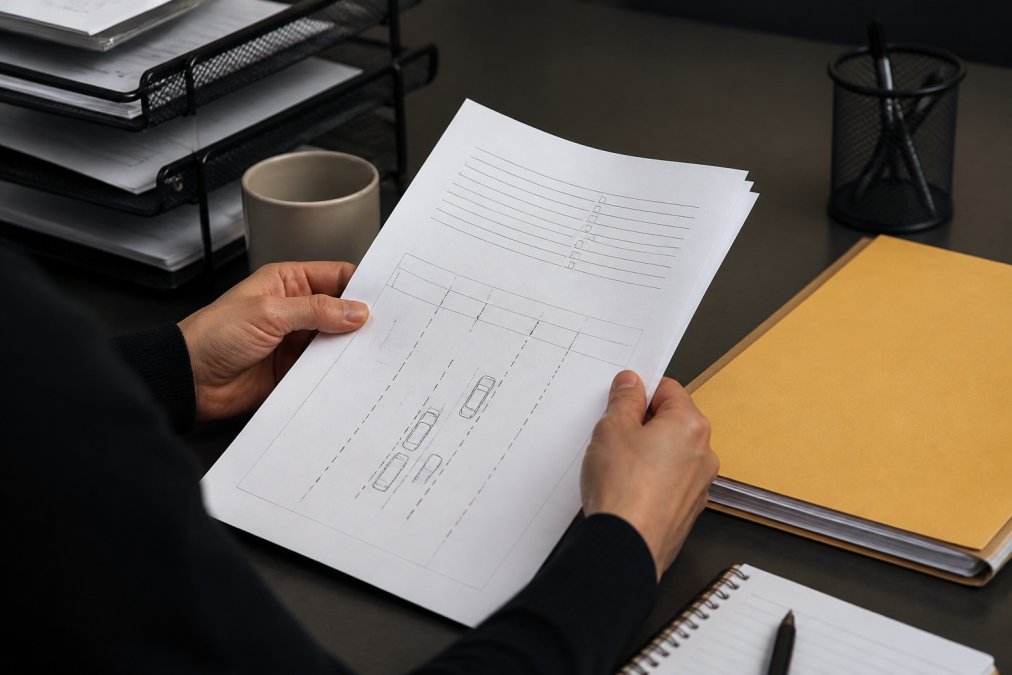
Table of Contents
- Understanding the Accident Diagram Section
- Basic Information and Crash Details on Your Report
- Identifying Contributing Circumstances and Primary Collision Factor
- How to Get a Police Accident Report in Georgia
- Georgia Accident Report Codes Explained
- What to Do If Your Accident Report Is Wrong
- Using Your Accident Report Diagram for Insurance Claims
- Frequently Asked Questions
Last Updated: September 20, 2026
Understanding the Accident Diagram Section
To get your FREE accident report fill out the yellow form at the bottom of the page.
An accident report diagram is a visual representation of how a motor vehicle accident occurred, showing vehicle positions, travel direction, point of impact, and other key crash details. It’s a map that tells the story of what happened. (Source: National Highway Traffic Safety Administration (NHTSA) guidelines)
The diagram is crucial for determining fault, supporting insurance claims, and verifying report accuracy.
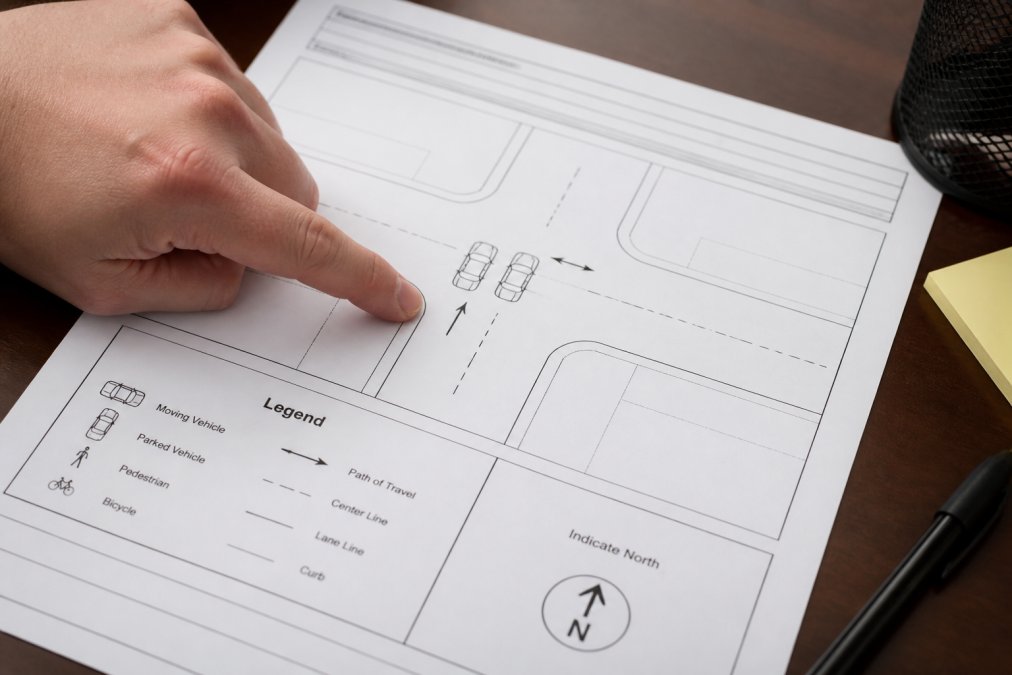
Common Diagram Symbols and What They Mean
Most accident diagrams use standardized symbols. Learning these is essential to reading any diagram accurately.
Vehicle Representation:
- Rectangles or squares represent vehicles, numbered to match the narrative.
- Solid lines show final resting position after impact.
- Dashed or dotted lines show the path of travel before impact, indicating direction and approximate speed.
Impact and Damage Indicators:
- The point of impact is marked with an X, star, or circled area.
- Damage notation shows which vehicle parts sustained damage via hatching, shading, or notes.
- Skid marks are long lines indicating locked brakes and sliding; length suggests vehicle speed at braking.
Direction and Location Markers:
- Directional arrows show each vehicle’s heading at impact.
- True north indicator (compass rose or “N” arrow) orients the diagram to actual compass direction.
- Street names and intersection layout are drawn to scale so you can verify the location.
Road Features:
- Traffic control devices (stop signs, lights, yield signs) are marked.
- Lane markings indicate lane count and vehicle positioning.
- Pedestrian crosswalks are shown if a pedestrian was involved.
- Curbs, medians, and barriers show obstacles affecting vehicle movement.
Why the Legend Matters
Not all police departments use identical symbols. Your report should include a legend explaining the specific symbols used. If you don’t see one, ask the police department to provide it. This prevents misinterpretation, a dashed line might represent a skid mark or an estimated path, which carry different meanings for fault analysis.
The diagram typically appears on page two or three, separate from the officer’s written narrative. Together, they paint a complete picture of the crash.
Basic Information and Crash Details on Your Report
Your accident report contains essential identifying information: date, time, location, GPS coordinates, police codes, and case number.
The report lists all vehicles with VIN, license plate, make/model/year, owner and driver names, and insurance information.
Property damage and bodily injury are noted separately, including emergency response and towing. This information matters for insurance claims and legal action.
Note the investigating officer’s name and badge number for disputes. The report date shows when it was filed, not when the accident occurred.
Identifying Contributing Circumstances and Primary Collision Factor
The contributing circumstances section lists factors that led to the crash: driver error, weather, road hazards, or traffic violations like speeding or failure to yield.
The primary collision factor is the main cause, only one factor listed. This determination heavily influences fault assignment.
Weather conditions (rain, snow, fog, ice) and road surface conditions (wet, loose gravel, potholes) are documented. Traffic control devices are noted.
Pedestrian involvement is documented clearly, including both pedestrian and driver actions. Vehicle maneuvers (unsafe lane changes, left turns into traffic, failure to brake) are described.
Errors often appear here when officers misinterpret events or rely on incomplete witness statements. If you believe the contributing circumstances are wrong, note it immediately.
How to Get a Police Accident Report in Georgia
Contact the appropriate agency: city police for city streets, Georgia State Patrol or county sheriff for county roads or highways.
Request a copy of your free accident report →
You’ll need the accident date, location, and driver names. Most agencies accept phone, in-person, or online requests.
Georgia Accident Report simplifies this process. Submit your information once and our team handles retrieval across all Georgia agencies. The report is free with no obligation.
Review your report within the first few days.
Georgia Accident Report Codes Explained
Police reports use codes to standardize information. Understanding them helps you read your diagram accurately and spot errors.
Injury and Damage Classification Codes
These codes determine official categorization:
- PDO = Property Damage Only (no injuries). Insurance claims are typically faster.
- PI = Personal Injury. Triggers additional investigation.
- FI = Fatal Injury. Results in detailed investigation and possible criminal charges.
- Hit and Run = Driver left the scene. Complicates liability and may involve criminal charges.
These codes directly affect insurance processing and liability. If you reported an injury but your report shows PDO, correct it immediately, it can undervalue your claim.
Collision Type Codes
These codes describe the physical impact and are critical for fault determination: (Source: Federal Highway Administration (FHWA) data on road features)
- Rear-end = One vehicle struck another from behind. The rear-struck vehicle is almost always not at fault.
- Head-on = Vehicles collided front-to-front. Fault depends on lane position and traffic control.
- Side swipe = Vehicles struck each other on the side. Fault depends on lane position and lane changes.
- Angle = Vehicles collided at 45-90 degrees, common at intersections. Fault depends on right-of-way and traffic control.
- Sideswipe (same direction) = Both vehicles traveling the same direction. Usually indicates an unsafe lane change.
Driver Action and Contributing Factor Codes
These codes explain driver behavior contributing to the crash:
- Speeding = Exceeding the posted speed limit. Major fault indicator.
- Failure to Yield = Not giving right-of-way. Common and usually a clear fault indicator.
- Improper Lane Change = Unsafe lane switching without signaling or checking blind spots.
- DUI = Driving under the influence. Criminal code on serious reports.
- Distracted Driving = Phone use, eating, or other attention diversion.
- Reckless Driving = Endangering others, often in high-speed incidents.
- Failure to Control = Lost control due to speed, road conditions, or mechanical failure.
Road and Weather Condition Codes
These codes document environmental factors that may have contributed to the accident:
- Dry = Dry pavement
- Wet = Wet pavement (rain, standing water, or recently cleaned)
- Snow/Ice = Snow or ice present on road surface
- Loose gravel = Unpaved or poorly maintained surface
- Fog = Reduced visibility due to fog
- Rain = Active rainfall at time of accident
- Dark (no street lights) = Nighttime with inadequate lighting
How Codes Interact with Diagram Interpretation
Codes don’t exist in isolation. They work together with the diagram to tell the story of fault. For example:
- A “rear-end” collision code combined with a diagram showing Vehicle 1 behind Vehicle 2 strongly suggests Vehicle 1 is at fault.
- A “failure to yield” code at an intersection should match a diagram showing the at-fault vehicle entering against a stop sign or red light.
- A “wet pavement” condition code combined with “failure to control” suggests the driver was speeding for conditions, not necessarily exceeding the posted limit.
Spotting Coding Errors
Common coding mistakes include:
- Wrong collision type assigned, The diagram doesn’t match the code. Request the officer review the diagram and correct the code.
- Contributing factors that don’t match the narrative, The officer wrote that you were speeding in the narrative but didn’t code it. Ask why.
- Missing codes, If weather was poor or a traffic violation occurred, those should be coded. If they’re absent, the report is incomplete.
- Conflicting codes, If the report codes both vehicles as “failure to yield,” that’s contradictory. Only one driver can fail to yield at a given moment.
Your report should have a legend or key that explains codes specific to your state. If you see a code you don’t recognize, ask the police department or your insurance adjuster. Don’t guess at what it means. Request a supplemental report or written clarification if codes seem wrong.
What to Do If Your Accident Report Is Wrong
Errors happen. An officer may have misunderstood what a witness said. They might have coded the wrong collision type. The diagram could show vehicles in incorrect positions. If you spot an error, act quickly.
Using Your Accident Report Diagram for Insurance Claims
Your insurance company needs the official police report to process your claim. They use the diagram to understand how the accident happened and assign fault. In Georgia, the at-fault driver’s insurance typically covers damages.
Frequently Asked Questions
What do the symbols on a police accident report diagram mean?
Police accident report diagrams use standardized symbols to show vehicle positions, directions, and impact points. Common symbols include arrows indicating vehicle movement and direction, circles or boxes representing vehicles, and marks showing the point of impact. The diagram legend, typically found at the bottom or side of the report, explains each symbol used. A true north indicator helps orient the intersection or roadway. Understanding these symbols is essential for interpreting how the crash investigation officer reconstructed the sequence of events and determining fault.
Can I contest the diagram in my official police accident report?
Yes, you can dispute errors in your accident report diagram if you believe the diagram misrepresents the crash scene or vehicle positions. File a supplemental report or written correction with the investigating police department, providing specific details about what is inaccurate. Include photos, witness statements, or other evidence supporting your correction. Some departments allow you to submit a formal dispute that becomes part of your official record. Contact your local police department or state patrol agency for their specific process. Having an inaccurate diagram corrected is important for insurance claims and any potential legal proceedings.
How long does it take to get a police accident report in Georgia?
The timeframe varies depending on the police department and whether the crash is still under investigation. Most reports are available within 5-10 business days, though complex crashes or those involving injuries may take longer. You can request your report directly from the investigating officer’s agency, through the state patrol, or by using a free retrieval service. If the report is not yet complete, the department will provide an estimated completion date. For urgent claims, contact the investigating officer directly to request expedited processing.
Why is the accident diagram critical for insurance claims?
The accident diagram is critical for insurance claims because it provides official documentation of vehicle positions, directions of travel, and the point of impact, which helps establish fault. Insurance companies use the diagram to verify your account of the crash and determine liability. The diagram also documents contributing circumstances, road conditions, and traffic control devices, all of which influence claim decisions. Without an accurate diagram, your insurance company may delay processing or dispute your claim. The official police report carries significant weight in settlement negotiations and is often required before an insurance company will approve payment for bodily injury or property damage.
Request a copy of your free accident report:
"*" indicates required fields